 BotChronicles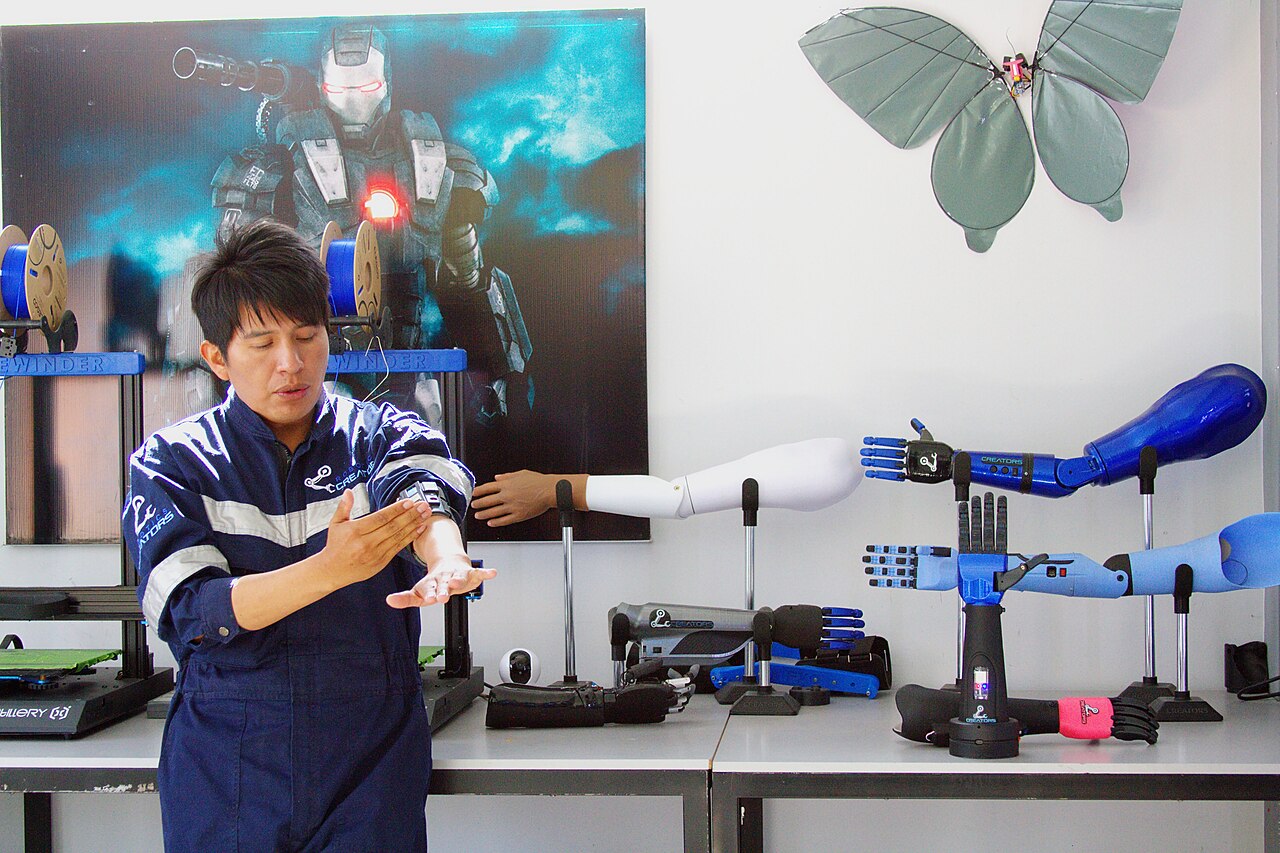
For decades, the most advanced prosthetic arms were engineering marvels that almost nobody could afford. A state-of-the-art myoelectric arm can cost around 200,000 dollars, roughly the price of a house in many regions, and insurance rarely covers the full amount. In 2026 that equation is finally starting to change, thanks to artificial intelligence, 3D printing and a wave of startups treating prosthetics as consumer robotics rather than rare medical devices.
An arm that learns its user
The most talked-about newcomer is Atom Touch, developed by the Californian startup Atom Bodies. The arm pairs surface EMG sensors with an AI neural interface that learns each user's muscle signals, letting wearers control individual fingers without any surgery. With more than ten motors in the hand and dozens of sensors providing haptic feedback, it is reported to approach a near-human range of motion. The headline number, though, is the price: around 25,000 dollars, close to what a basic body-powered hook costs today. More than 11,000 people have reportedly joined the waiting list, with clinical trials planned ahead of FDA approval.
This is a real inversion of the old logic. Earlier myoelectric hands forced users to learn awkward muscle codes and switch between preset grips. Machine learning flips the burden: the software adapts to the person, decoding natural muscle activity and improving with use.
From children's superhero arms to a sense of touch
In the UK, Open Bionics has pushed accessibility from another angle. Its 3D-printed Hero Arm was the first multi-grip myoelectric arm available to children as young as eight, and the company reports that its new Hero RGD and Hero PRO hands are now available through NHS centres after eight years of lobbying. Across the Atlantic, the Hero Arm is offered in more than 800 US clinic locations.
The next frontier is sensation. Research groups are testing nerve stimulation, both implanted electrodes and non-invasive skin stimulation, to give wearers back a sense of touch and pressure. A 2025 review in npj Biomedical Innovations describes how restoring somatosensory feedback improves embodiment, reduces the perceived weight of the prosthesis and, for leg amputees, measurably improves balance and gait symmetry.
Caution is still warranted. Atom Touch has yet to complete clinical trials, reimbursement systems move slowly, and long-term durability outside the lab remains to be proven. But the direction is unmistakable: bionic limbs are becoming lighter, smarter and radically cheaper. If the 2010s made advanced prosthetics possible, the 2020s are making them affordable, and that may matter far more.