 BotChronicles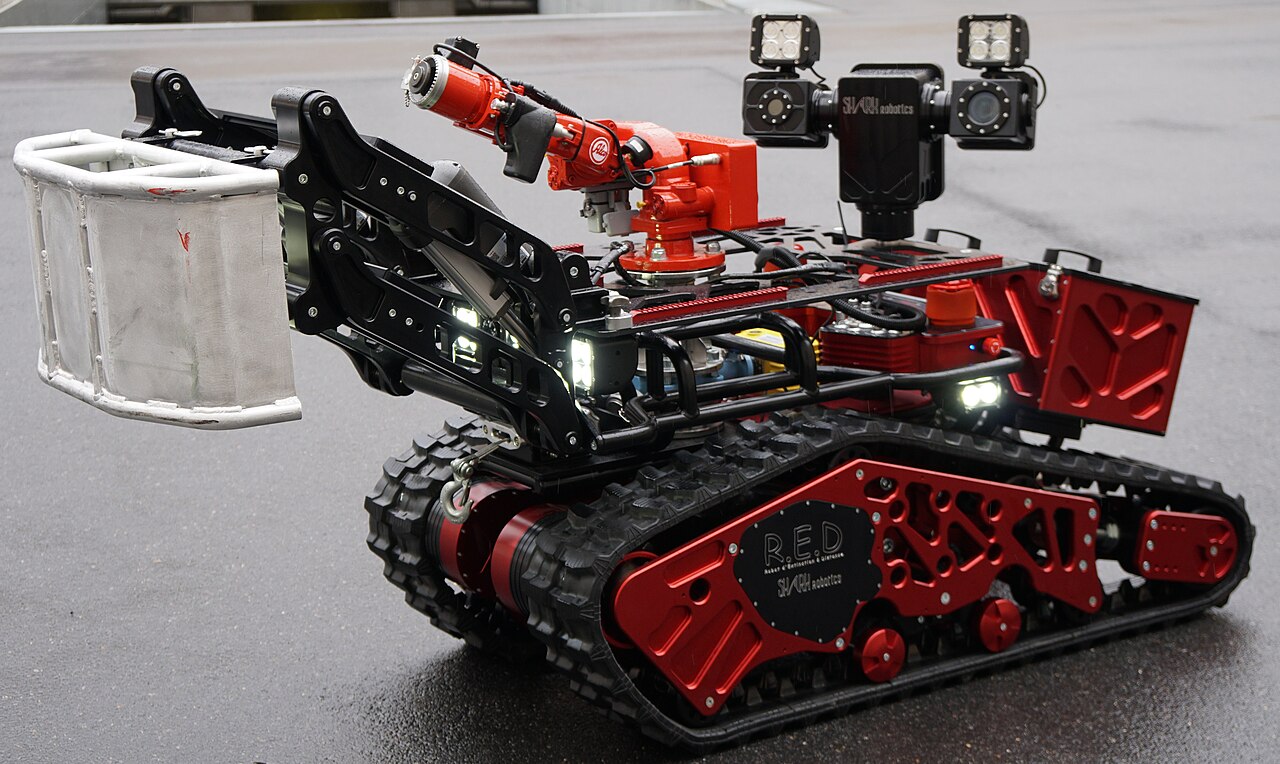
Firefighting has always demanded that humans run toward the one thing every instinct says to flee. In 2026 that equation is quietly changing. A new generation of ground robots is being sent first into collapsing, superheated, smoke-choked scenes — not to replace firefighters, but to take the lethal first step on their behalf.
The clearest signal came in February, when Hyundai Motor Group donated four Unmanned Firefighting Robots to South Korea's National Fire Agency at a ceremony near Seoul, as reported by the company and trade press. Two units went straight into live service with elite 119 rescue teams. Built on Hyundai Rotem's electric HR-Sherpa platform, the machine is essentially a remote-controlled tank with a water cannon — but the engineering details are what make it survivable.
Engineered to live in the fire
According to Hyundai, a "self-spraying" system wraps the robot in a continuous curtain of water, holding its body around 50–60°C even as the surrounding air hits 800°C. An AI vision camera sees through dense smoke, a six-wheel in-wheel motor system claws over rubble, and a long luminescent hose trails back to the pump. Its first real-world test, the company says, was a factory fire in North Chungcheong Province in late January. The stakes are not abstract: the Korea National Fire Agency reportedly recorded 1,788 firefighters killed or injured at fire scenes over the past decade.
From buildings to the wildland
South Korea is not alone. By early 2026, fire services across the United States, Europe, Japan and China are reported to be folding robots into routine operations — from tracked machines like France's Colossus, a Shark Robotics unit used at major structure fires, and the US-built Thermite, to quadruped "robot dogs" that scout unstable buildings. Outdoors, the wildfire fight leans on autonomous drones that map fire perimeters through smoke and ground vehicles that haul hose and supplies up terrain too steep or toxic for crews. Analysts tracking the sector expect the firefighting-robot market to grow at double-digit rates through the next decade, driven by worsening wildfire seasons and tightening worker-safety rules.
None of this makes the human firefighter obsolete. Robots are slow, expensive, and still depend on an operator's judgement at the other end of the link. But the direction is set: the most dangerous minutes of a fire — the breach, the search, the first attack on the seat of the blaze — are increasingly a job we can hand to a machine. For a profession measured in lives lost, that may be the most humane automation story of the year.